
Originally published by Matthew Cranston of The Australian
21.04.2026
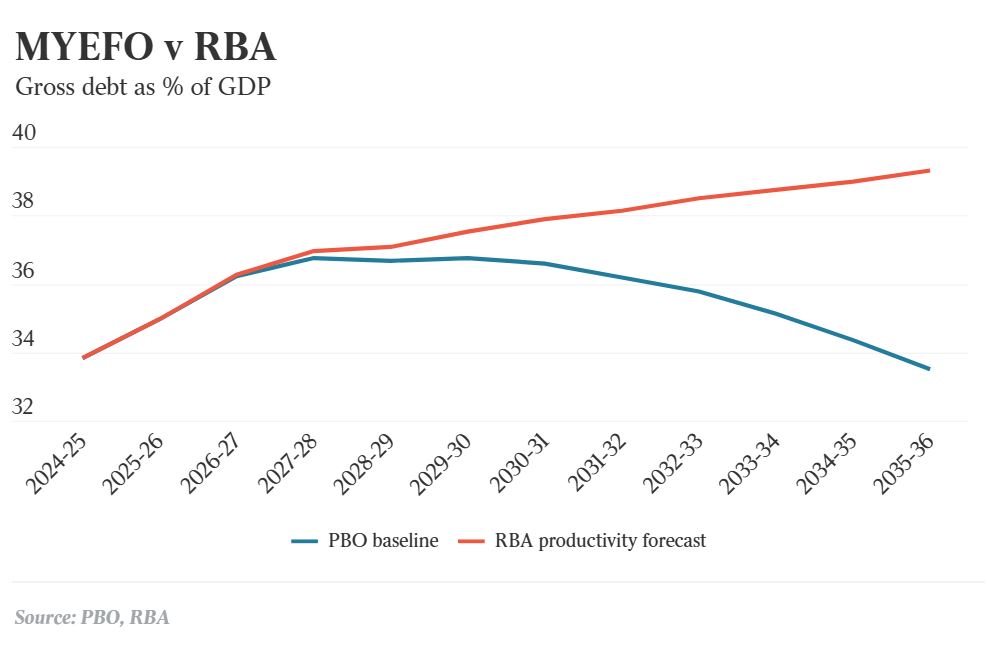
Lacklustre productivity growth rates mean Labor’s debt levels will not peak in 2028 as Treasury assumes but will keep rising well into the next decade, as new polling shows 70 per cent of Australians are very or somewhat worried about the size of national debt.
Analysis by The Australian using the independent Parliamentary Budget Office budget tool shows that the Reserve Bank’s productivity assumptions over the next few years will result in gross debt rising far beyond Treasury’s estimate in its most recent budget update in December.
The Liberal Party on Tuesday launched a national debt clock showing the country’s total debt has reached $960bn, after coming as close to the $1 trillion mark as $999bn earlier this month.
Former treasurer Peter Costello said on Tuesday – the 20th anniversary of the country’s net debt reaching zero under his stewardship – that bulging national debt would be hard to unwind.
Mr Costello accused the Albanese government of using the Middle East conflict as an excuse not to engage in proper budget repair.
“How did Australia lose its way so badly? Debt-free government should have been a bequest to generations of future Australians,” Mr Costello told The Australian.
A Newspoll survey of 1237 people shows concerns around debt are evenly distributed across age groups with 66 per cent of 18 to 34-year-olds worried, 68 per cent of both 35 to 49-year-olds and 50 to 64-year-olds and 77 per cent of those over the age of 65. Women (73 per cent) are more worried about national debt than men (66 per cent). But there is variance based on political support.
Only 53 per cent of Labor voters are worried as opposed to 83 per cent of Coalition voters and 84 per cent of One Nation supporters. About 60 per cent of the Greens voters are worried.
Across education levels those with TAFE and college education were more worried about debt levels (71 per cent) than those with a university education (67 per cent).
“The government will no doubt blame our poor position on Iran,” Mr Costello said. “Our poor position has accumulated over years of neglect and will be exposed by Iran.”
The Reserve Bank has estimated the productivity growth rate in Australia will be just 0.6 per cent over the next year and a half, before inching up to 0.7 per cent in late 2027 and 2028.
Last month Jim Chalmers announced that Treasury had changed its expectations on productivity growth rates in Australia saying that its assumption of 1.2 per cent would not be reached by 2030 – a delay of four years.
Applying the RBA’s productivity forecasts shows that the Albanese government’s own economic and fiscal strategy published within the budget would not be achieved.
“The government will improve the budget position in a measured way, consistent with the overarching goal of reducing gross debt as a share of the economy over time,” the strategy says.
“This approach enables fiscal policy to respond to changes in economic conditions to support macroeconomic stability, including in times of high inflation.”
With high and rising debt, low productivity growth and high government spending, economists say that would only place further pressure on inflation.
The Treasurer has pointed to overseas comparisons to argue Australia’s debt position is in good standing. Dr Chalmers noted last week that Australia had the fifth lowest debt as a share of GDP in the G20.
“We’ve got the debt down very substantially, we’ve delivered a couple of surpluses, the budget is in much better nick now than it was when we came to office, but we know that there’s more work to do,” Dr Chalmers said.
Launching the national debt clock on Tuesday, opposition Treasury spokesman Tim Wilson and opposition finance spokeswoman Claire Chandler were critical of Labor’s management of debt levels.
“The federal debt is now equivalent to ten credit cards per Australian, and with every dollar of debt it is just more petrol on the inflation fire,” Mr Wilson said.
“The greatest intergenerational policy is to let the next generation of Australians decide their own destiny with opportunity, not be born into debt servicing servitude and a zero-sum race to the redistribution bottom”.
Senator Chandler outlined the historical significance of current net debt levels.
“The Howard-Costello government inherited 18.1 per cent of GDP in net debt from Labor in 1996,” Senator Chandler said.
“Through a decade of disciplined management they brought it to zero. That strong foundation prepared Australia for the global financial crisis.
“The Coalition that followed the Rudd-Gillard-Rudd years did the same, bringing discipline back to the budget and preparing us for the Covid-19 pandemic.
“After just four years of the Albanese Labor government, net debt is already at 20.1 per cent of GDP more than Labor left the Coalition in 1996.”