
Originally published by Ben Harvey of The West Australian.
15.05.2026
WA is being thrown into a constitutional brawl with Canberra over an imminent Federal “takeover” of the State’s gas industry amid warnings the new laws could trigger diplomatic friction with two of Australia’s most important allies.
The Albanese Government’s new gas policy, which will force companies to send the equivalent of 20 per cent of their exports to the domestic market each year, is at loggerheads with WA’s own reservation laws.
WA requires producers to quarantine for local consumers 15 per cent of production over the course of a project’s lifetime.
Canberra is scrambling to accommodate WA’s successful 20-year-old system but the constitutional requirement to apply Federal laws uniformly means the State regime could become collateral damage.
Former WA Premier Colin Barnett said the national gas policy amounted to a Federal seizure of one of the State’s most important industries.
“It’s quite clear they are trying to take over Western Australia’s gas industry,” he said.
“It is a similar situation to when the mining super profits tax was considered. Canberra is jealous of this State’s fossil fuel industry and the relationship it has fostered with Asia.”
Federal Resources Minister Madeleine King, who represents the WA seat of Brand, is backing the State regime but is caught between the constitution and Energy Minister Chris Bowen.
“The fundamentals of the Western Australia gas market are different to those of the east coast gas market,” she said.
“The WA gas reservation scheme has ensured the WA domestic market is well supplied and domestic prices are insulated from international price spikes.
“How the national scheme will apply in WA will be resolved during the next stage of design work.
“That work will consider interactions with State reservation policy. As a starting point, we anticipate that obligations for WA will count towards the national obligation.”
Respected oil and gas analyst Saul Kavonic said the decision to meddle in WA’s affairs was “as stupid as it is galling”.
“Western Australia is the only State with the foresight to have a properly working reservation policy, and is more than capable of managing their gas market themselves,” he said.
WA doesn’t need the politicians who have overseen the east coast gas market debacle to bring their foolish ideas over to the west.
“If Canberra persist in trying to capture Western Australia within their reservation policy, it could prove the policy’s undoing.
“By targeting WA, Federal Labor will be dragging Woodside, the entirety of Japan Inc, Exxon and Chevron, and by extension the Trump administration, into lobbying against it; a fight Canberra doesn’t need and would likely lose.”
The Japanese Government has a 22 per cent stake in Inpex’s $72 billion Ichthys project, which pipes gas from a field off the WA coast to an LNG plant in Darwin. The Darwin facility has no domestic gas facility, which means the company will have to fulfill its 20 per cent obligation by buying uncontracted gas off other companies.
Tokyo-headquartered JERA and LNG Japan are stakeholders in the Scarborough gas project while Japanese giants Mitsui and Mitsubishi own part of the North-West Shelf.
Chevron, which President Trump is relying on to commercialise Venezuela’s oil reserves, spent close to $100 billion on the Gorgon and Wheatstone LNG projects in WA’s north. The company faces huge bills to retrofit the domestic gas plants at each facility to accommodate the extra gas they could have to process each year under the Federal plan.
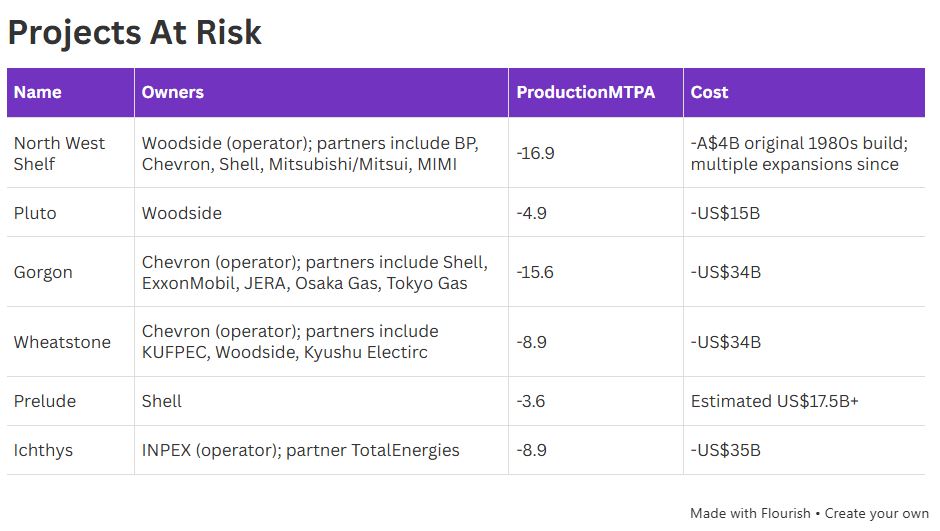
Insiders at the California-headquartered major believe Washington will see the sudden change of rules as the quasi-nationalisation of a US company.
The WA Government has welcomed the Commonwealth’s decision to emulate the State’s reservation policy but is wary of a heavy-handed application locally.
“The WA State Government has engaged with the Commonwealth to understand the policy implications of its decision and has been assured WA’s existing domestic gas reservation policy will satisfy any requirements of a national scheme,” a spokesperson said.
“WA’s policy has played an important role in keeping the State’s economy the strongest in the nation by guaranteeing a reliable supply of gas through the energy transition.
“It coexists with an LNG industry that is among the strongest and most competitive in the world while ensuring gas remains an affordable and reliable form of energy for WA households and businesses.”
It is understood the volume of domestic gas which would be yielded under the Federal 20 per cent-of-exports rule is close to the amount supplied under the State 15 per cent-of-production regime.
But under the Federal system, companies operating in WA would have to supply the domestic gas each year instead of over the course of a project’s lifetime.
Observers believe the new laws could swamp the local market and push domestic-only producers to the wall.