
Originally published by Bevis Yeo of The Daily Telegraph
16.04.2026
Resource-rich Western Australia will need new gas and renewable energy sources along with storage to address projected energy shortfalls.
It may come as a surprise for anyone with more than a passing familiarity with Western Australia that the country’s resources powerhouse actually has some serious concerns about energy security.
After all, the state has massive gas resources off its northwest coast and benefitted from astute governments that wrangled a domestic gas reservation policy that kept prices low for a long time.
However, times have changed with the Australian Energy Market Operator (AEMO) warning in December 2025 that while the state’s domestic gas market remained broadly balanced in the near-term, potential supply gaps could emerge from 2030.
In its 2025 WA Gas Statement of Opportunities, it noted that production declining faster than consumption could result in a 11 terajoules per day gap emerging in 2030 that could widen to 478TJ/day in 2045.
While gas is also used for industrial purposes such as production of fertiliser, the consumption is driven significantly by electricity generation in WA’s main electricity grid.
AEMO executive general manager WA Kirsten Rose said that gas consumption for electricity generation would become more variable and seasonal to support high demand periods and times when renewable sources were not performing strongly.
Matters are certainly not helped by the state retiring its coal-fired plants by 2030 and new grid-scale renewable energy projects still few and far between to date.
Highlighting this concern, the AEMO noted in June 2025 that ongoing investment in generation and storage was required to manage growing peak demand and offset the retirements of the coal plants, which produce about a quarter of the state’s energy as of early 2026.
The Iran conflict reducing crude oil exports, Cyclone Narelle temporarily shutting down WA LNG exports and the state government activating emergency powers to ensure fuel goes where it needs further underscores the importance of energy security.
A matter of access
Speaking to Stockhead, Equus Energy (ASX:EQU) managing director Will Barker said that as a major energy producer that had large, discovered and undeveloped gas resources and established infrastructure near key Asian markets, WA was in a privileged position.
It also had a stable and reliable jurisdiction preferred by LNG countries like Japan and South Korea.
“Australia is already one of the world’s largest LNG exporters (around ~20% of global supply), with WA playing a central role,” he noted.
“This creates a long-term opportunity for WA to supply both domestic and international markets for decades to come.”
He flagged the state’s key issue wasn’t actually the availability of gas resources or capital, it was getting access to existing infrastructure for gas processing.
“Existing infrastructure like the Karratha Gas Plant, Varanus Island and Devil Creek have spare capacity due to a lack of feedgas,” Barker noted.
“The fastest and most efficient way to respond is to accelerate development of known gas resources (including the Browse, Equus and Perth Basin) and tie them into this existing infrastructure.
“This requires alignment between government, resource owners and infrastructure operators to unlock supply more quickly.”
He added that bringing new upstream gas supply strengthened the domestic gas market, which underpinned the state’s industry – mining, fertiliser, chemicals and power generation, and LNG exports that bolstered energy security for Australia’s major trading partners.
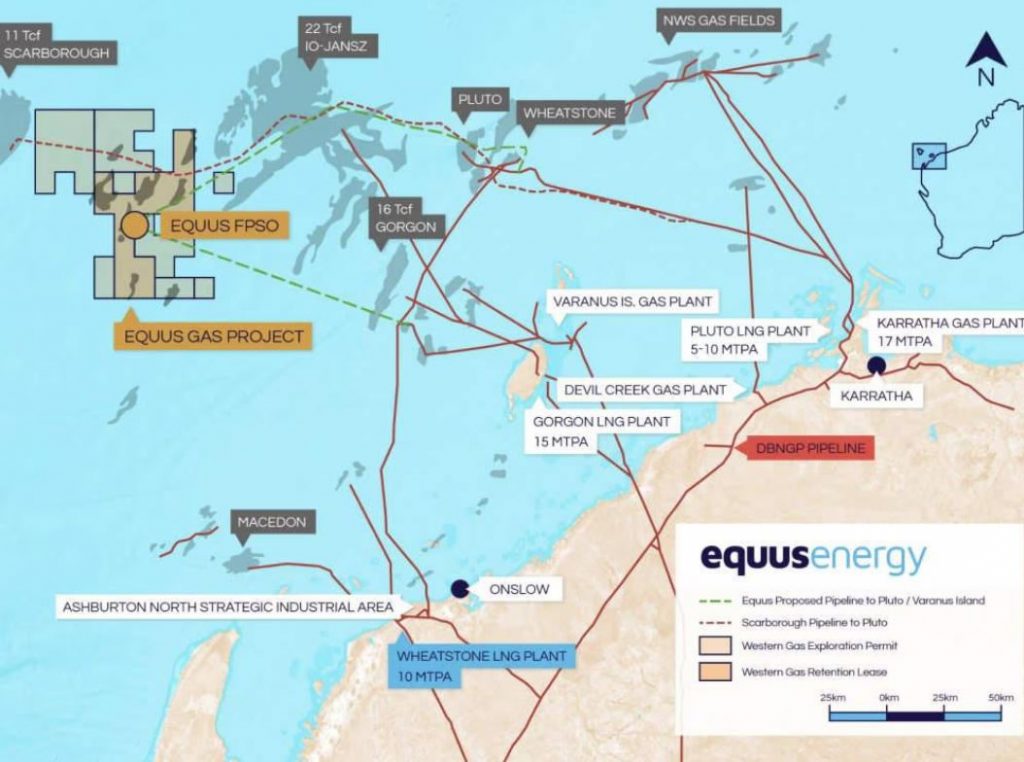
EQU itself owns the Equus gas field that hosts a certified resource of nearly 2 trillion cubic feet of gas in the heart of the North West Shelf close to existing infrastructure and processing capacity.
This is enough gas to provide a material, incremental source of domestic gas while supporting LNG exports of ~2Mtpa through the existing infrastructure.
“Over the next 2–3 years, the focus is on progressing towards FID and working with infrastructure owners to enable tie-back development options into facilities such as Karratha Gas Plant and Varanus Island,” Barker said.
“Equus is fully committed to the WA domestic gas policy and has signed a gas supply and funding agreement with Alcoa.
“It provides Alcoa with the exclusive right to 50TJ/day for a 10 year contract term and provides up to US$30m in funding to advance Equus to FID.
“In the near term, there is also potential to support optimisation of existing production through gas swap or replacement arrangements — helping maximise utilisation of existing infrastructure while new supply is brought online.”
More than just gas
However, gas alone isn’t enough to ensure WA’s energy security, a point that Barker acknowledges.
He said the state needed more gas supply alongside continued growth in renewables and battery storage.
“WA is a significant industrial user of gas, particularly across mining and processing sectors, and many of these applications cannot simply be replaced by renewables,” Barker added.
“At the same time, renewables and storage will continue to grow and play a larger role in the energy mix.
“The focus should be on ensuring both systems develop in parallel to support reliability, affordability and long-term transition.”
Batteries already play a significant role in meeting peak demand with the Federal Government’s recent battery incentives leading to a surge in home battery installations that has already reduced household reliance on the grid.
WA energy plays
Besides Equus Energy, there are a number of ASX juniors moving to help meet the state’s energy needs.
Frontier Energy (ASX:FHE) is progressing development of its Stage One Waroona renewable energy project in WA.
Stage one of this project will have 120MW of solar generation capacity and 81.5MWh of battery capacity that can provide power over a six-hour period.
In October 2025, the company secured fixed price capacity credits under the Reserve Capacity Mechanism, which provides guaranteed revenue of about $32m per year through to 2032.
This exceeds forecast debt service obligations (interest expense plus principal repayment) and estimated operating costs, providing a level of revenue certainty that is an important requirement of senior debt financiers.
The company is focused on securing funding after receiving indicative senior debt terms from leading financial institutions.
It has already received up to $100m in mezzanine financing proposals, which may be considered as part of the total funding package for the project’s development, and is close to finalising major supply contracts for key equipment such as batteries, solar panels, trackers and inverters from tier one suppliers.
A process to shortlist preferred banks will now begin with the aim of completing due diligence and credit approved term sheets as soon as possible.
To support this process, the company has appointed lawyers to undertake legal due diligence and assist with key procurement contracts.
Buru Energy (ASX:BRU) is focused on securing $40m in funding for the planned 2026 Rafael resource and flow rate validation program along with subsequent independent reserves certification.
This process has attracted international and domestic parties who are undertaking detailed due diligence on the opportunity to participate in the project.
Conducting the validation is the primary condition to finalising binding agreements with Buru’s strategic development partner, Clean Energy Fuels Australia (CEFA), and reaching a final investment decision (FID) for the project in the second half of 2026.
The program includes drilling the Rafael-2H well and recompleting the Radael-1 well, potentially with horizontal sections.
Drilling activities are targeted to start in Q2 2026, subject to the upstream funding partner selection process.
Strike Energy (ASX:STX) generated $36m in sales revenue from 3.8 petajoules of gas and condensate production from its Walyering gas field in the Perth Basin into WA’s domestic market.
It is progressing the production optimisation strategy for Walyering in Q2 2026 and is advancing Walyering West-1 towards spud in mid-April 2026.
The company is also progressing its 85 megawatt South Erregulla peaking gas power project, which was 86% complete as of late February 2026.
South Erregulla remains on track and on budget for targeted completion on October 1, 2026.
STX has already secured final 2027-28 Reserve Capacity Price of $360,700 per megawatts, underpinning ~$30.7m of firm capacity revenue in the second year of operations at the plant.
Stepping away from gas and renewables, Carnarvon Energy (ASX:CVN) has interests in some of Australia’s largest undeveloped offshore oil resources in the Bedout Sub-basin offshore Western Australia.
It holds a 10% interest in the Dorado oil field that was discovered in 2018 and has gross best estimate (2C) contingent resource of 162 million barrels of light oil and condensate along with 748 billion cubic feet of gas.
The company also has a 20% stake in WA-438-P, which hosts the Pavo North discovery that has gross 2C contingent resources of 43MMbbl.
CVN is investigating options to accelerate development of the two fields, which could be handled by a single floating, production, storage and offloading vessel.
It is finalising plans to drill an exploration well in H1 2027 that will test the same play system as Dorado and potentially new play types.